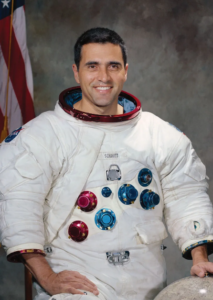
That is right, 11 of 12, 92%. That is a pretty impressive number. Let’s walk through them from start to finish.
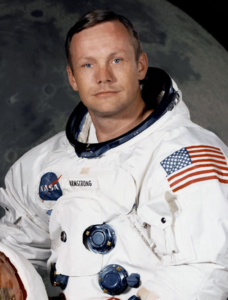
Neil Armstrong was the first man to set foot on the lunar surface, and he was an Eagle Scout. He earned his Eagle Scout in 1947 as a member of Troop 14 in Wapakoneta, Ohio. During his Scouting journey, he completed 26 merit badges, including Aviation, Pathfinding, and Pioneering, reflecting his early interest in flight and exploration. As an adult, he was recognized by BSA with the Distinguished Eagle Scout Award and Silver Buffalo. While flying toward the Moon on July 18, 1969, he sent his regards to attendees at the National Scout jamboree in Idaho. Among the few personal items that he carried with him to the Moon and back was a World Scout Badge to affirm his commitment to Scouting.
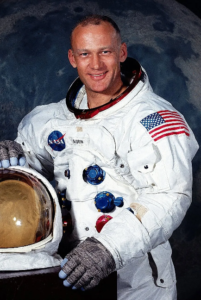
Buzz Aldrin accompanied Neil Armstrong to the moon and set foot on its surface shortly after him. He grew up in Montclair New Jersey where he was a Cub Scout and a Boy Scout, earning the rank of Tenderfoot. An interesting tidbit about Buzz is he was born Edwin Eugene Aldrin Jr., not Buzz. It was a nickname that originated because one of his sisters had difficulty pronouncing “brother”. She instead said “buzzer” which was shortened to “Buzz”. He legally changed his first name to Buzz in 1988. Aldrin was also the first astronaut to hold a doctoral degree. That, and his expertise in orbital mechanics earned him the nickname “Doctor Rendevous” amongst his fellow astronauts. Buzz Aldrin was a man of many names it seems.
Pete Conrad was amongst the shortest NASA astronauts at only 5 feet 6 1/2 inches. He was a Cub Scout. By Chance, Conrad landed on the moon on November 19, 1969 as commander of the Apollo 12 mission. I say by chance because it was chance that pushed him from commander of Apollo 11 to commander of Apollo 12. As he stepped off of the ladder of the lunar lander onto the surface of the moon, he apparently couldn’t resist taking a poke at his own diminuitive size by saying “Whoopee! Man, that may have been a small one for Neil, but that’s a long one for me.“. He later revealed that he said this in order to win a bet he had made with the Italian journalist Orianna Fallaci for $500 to prove that NASA did not script astronaut comments. Fallaci was convinced that Armstrong’s “One small step for man” statement had been written for him and was not his own words
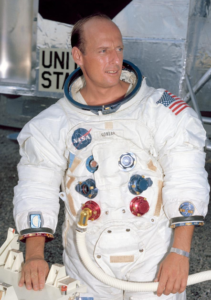
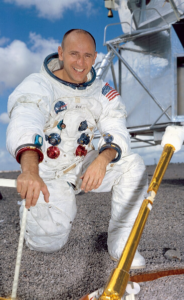
Alan Bean was a Boy Scout and he earned the rank of First Class. He accompanied Pete Conrad to the lunar surface on Apollo 12. He retired from NASA in 1981 to take up painting saying he was fortunate enough to visit worlds and see sights no artist’s eye, past or present, has ever viewed firsthand and he hoped to express these experiences through his art. One of his paintings, “The Fabulous Photo We Never Took“, depicted a photo he had hoped to take of both he and Conrad together in order to befuddle the NASA mission scientists (How can they both be in the picture?). The photo was NOT taken because he was unable to find the self-timer he had brought with him.
As an artist, Bean brought color into his lunar paintings and he added a magic touch to each one… real moon dust.
Alan Shepard, known as the first American in space, was remarkable in many ways besides walking on the moon as commander of Apollo 14. He not only earned the rank of 1st class in the Boy Scouts (1936), but he earned the rank of Rear Admiral in the US Navy (the first astronaut to do so). He was a brilliant academic as a youth, skipping both the 6th and 8th grades. He easily passed the entrance exam for the US Naval Academy in 1940 but was too young to enter at just 16 years of age, so his entrance was delayed until 1941. Due to the war, the class of 1945 actually graduated in 1944 so shepard saw action in the Pacific at the end of WWII. A famous quote from Alan Shepard came when reporters asked him what he thought about while sitting atop the Redstone rocket before his first foray into space. He answered “The fact that every part of this ship was built by the lowest bidder.“.
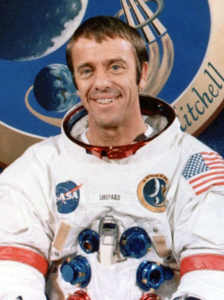
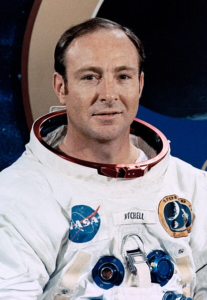
Edgar Mitchell was born in Hereford, Texas but grew up in New Mexico where he earned Life Scout in the Boy Scouts. As an astronaut, Mitchell earned the Presidential Medal of Freedom for his work as part of the mission operations team for Apollo 13 that brought the crew safely home after an oxygen tank explosion aborted their planned moon landing. He accompanied Alan Shepard to the lunar surface, piloting the lunar lander. Edgar was interested in parapsychology and he claimed to have conducted private ESP experiments with his friends on Earth. The results of these experiments were published in the Journal of Parapsychology in 1971. Edgar Mitchell’s quote? “From out there on the moon, international politics look so petty. You want to grab a politician by the scruff of the neck and drag him a quarter of a million miles out and say, Look at that, you son of a…“. We will end the quote there.
David Randolf Scott was not named for the famous screen actor (Randolf Scott) but for the airbase he was born on, Randolf Field near San Antonio, Texas. He grew up at bases across the country and overseas but he still managed to earn Life Scout in the BSA. Scott flew with Apollo 15 as commander and became the 7th person to step on the moon on July 30 1971. Scott had the distinction of having a lunar rock named for him, “Great Scott”. On the same lunar mission he collected a rock later dubbed as the genesis rock because it was from the moon’s crust when it was formed. Scott’s moon trip was also marred by a scandal where he and the Apollo 15 crew carried 400 postal covers to the moon without NASA approval.
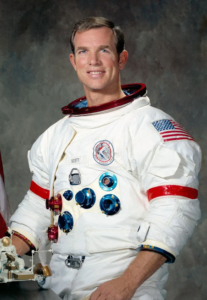
The 8th person to step foot on the moon was not a scout so is not covered here.
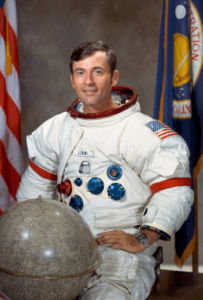
John Young was the commander of Appollo 16 and was the 9th person to walk on the moon. He earned the rank of 2nd class in the Boy Scouts of America. Young holds the distinction of being the only American to have flown in 4 different space craft including Gemini, Apollo command and lunar module, as well as the space shuttle. The Apollo 16 mission had several glitches prior to the lunar landing leading to Young’s quote when stepping onto the moon “I’m glad they got ol’ Brer Rabbit here, back in the briar patch where he belongs”. Young’s brush with controversy was on his Gemini 3 flight when he smuggled aboard a corned beef sandwich which he shared with fellow astronaut Gus Grissom while testing food in space. The US House Appropriations committee launched an investigation into the incident.
Charles Duke was the only other Eagle Scout to walk on the moon, besides Neil Armstrong. As lunar module pilot for Apollo 16, he was the 10th, and youngest, man to set foot on the lunar surface. His distinctive southern drawl became famous as the voice of mission control for the Apollo 11 mission when an overly long descent depleted much of the fuel. When the astronauts safely landed he said “Roger, Twank…Tranquility, we copy you on the ground. You got a bunch of guys about to turn blue. We’re breathing again. Thanks a lot!”. You may also know him as the man that exposed both the primary and backup crews of Apollo 13 to the german measles. Another interesting tidbit is that he was the first identical twin to fly in space… or was it his brother William?
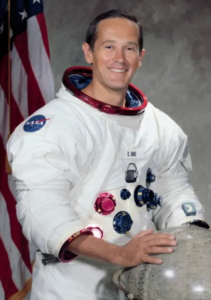
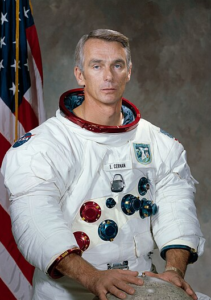
Apollo 17 was the last mission to the moon and 2nd class scout Eugene Cernan was its commander. Cernan was originally offered the chance to walk on the moon as lunar module pilot for Apollo 16 but declined in favor of commanding the Apollo 17 mission. He holds several lunar records including the longest time on the lunar surface, the last man to walk on the moon, and the lunar land speed record (11.2 mph). Coincidentally, Pudue University is the alma mater of both the first and last men to walk on the moon.
Gene Cernan gave the eulogy at Neil Armstrong’s funeral.
Harrison “Jack” Schmitt was the twelfth person to set foot on the moon following Apollo 17 commander Gene Cernan. He is also the only non-military astronaut to touch the moon. Though his crewmates on Apollo 17 make the same claim, Schmitt says he is the one that actually took the iconic photograph of the Earth from space now known as the “Blue Marble”, NASA credits all three. On retiring from NASA in 1975, Schmitt was elected to the US Senate where he served as chairman of the Science, Technology, and Space subcommittee. He served only one term.
A final astronaut quote for this artical is from Harrison Schmitt… “Perhaps the hardest thing to get used to on the Moon is that the sky is completely black. There’s no blue at all.”