
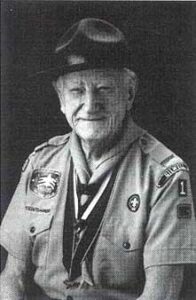
 Born in Denmark as Vilhelm Hans Bjerregaard Jensen in 1900, he was continuously active in Scouting from its earliest years (1910) to his death in 1992. Vilhelm joined Scouting in denmark as a youth in 1910 and went on to earn their highest award, Knight Scout (think Eagle Scout) in 1917. In 1920, he represented his troop at the first world scout jamboree in London, where he met Baden-Powell. He continued in Danish Scouting into 1028 as a Scoutmaster, national instructor, and writer and editor for their scouting journal.
Wilhelm decided to experience Scouting around the world and in 1925 to early 1926 he toured Europe and England until he finally landing on American shores in February 1926 where he went to work for the still fledgling Boy Scouts of America in various capacities from teaching native american dance to hauling and moving boxes in the supply division.
But by 1927 he was working in the BSA national office. The story goes that he got on an elevator in the national office that James E. West was riding. Mr. West asked Wilhelm his impression of American Scouting. Wilhelm’s answer was in the form of an 18-page memorandum detailing various issues, focusing especially on the poor implementation of the patrol method.That earned him a job as a writer and editor which led to the first Patrol Leader Handbook in 1929.
It was 1930 when Wilhelm became William. He changed his name ny anglicizing the first name and translating Bjerregaard to Hillcourt (He just dropped Jensen). And the nickname? Green Bar Bill was perhaps a forseeable moniker given that he wrote the first patrol leader handbook and the patrol leader’s badge is 2 green bars. Capitol Area Council’s own Peter Sargeant met Green Bar Bill and related that he always carried 2 pens to sign his name, a blue one for his name and a green one for the 2 bars.
Bill Hillcourt was a prolific writer. Besides the patrol leader handbook, he authored a scoutmaster manual, 3 editions of the Boy Scout Handbook, 33 years of contributions to Boy’s Life magazine, and, with Baden-Powell’s widow, the difinitive biography of Scouting’s founder, Baden-Powell: The Two Lives of a Hero. This doesn’t even touch on the updates and edits he contributed to so many other of Scouting’s written words.
And there are stories behind his writings… The Scoutmaster manual he wrote in the mid-1930’s wasn’t just memories, teachings, and experiences plucked from his head. In 1934, Green Bar Bill moved with his new wife, Grace Brown (James West’s personal secretary), to a home near Schiff Scout Reservation, BSA’s national training center. There he founded Troop 1 of Mendham, New Jersey so he could put his ideas and theories to the test before including them in his writings. It was there also that he met the Baden-Powells. That first meeting forged a life-long friendship.
Another interesting story behind the story is the 3 Boy Scout Handbooks he wrote. You see, Bill wrote 2 of those handbook as an employee of BSA national, but he retired in 1965. He took that opportunity to finish the around-the-world trip he started in 1926. By 1971 he was back in the USA. 1972 saw the publication of a new Boy Scout Handbook that many (including Bill) said took the “outing” out of “scouting”. The changes were hoped to expand the scope of Scouting and catch up with the times, but it failed to bring in very many new Scouts. Bill convinced the BSA that the changes were a mistake and he was brought back in to write his 3rd edition of the iconic handbook.
I apologize for going on about Green Bar Bill but I haven’t shared half of what there is to tell. Bill stayed active in the BSA until his death in 1992. He is arguably one of the most influential figures in the BSA, perhaps even more so that some of its founders.